
What are 7 data normalisations in database for Frontend Developers? Why do we need them in frontend?

Index:
What is Data Normalization?
What is Frontend Data Normalization?
What are Data Normal Forms in Database?
What are Data Normal Forms in Frontend?
When NOT to Normalize in Frontend
How Normalization Helps Memory Management?
Conclusion
As developers, we often think of “Data Normalization” as a backend concern—something the database administrators handle during the schema design phase.
However, as modern frontend applications grow in complexity (think Redux, TanStack Query, or massive context providers), the way we structure data on the client side has become just as critical.
What is Data Normalization?
Data normalization is the process of organizing data in a database to reduce redundancy and improve data integrity. It involves structuring tables and their relationships according to a series of rules (normal forms) to eliminate duplication and ensure data dependencies make logical sense.
Why Normalize Data?
The primary goals of normalization include:
Eliminating redundant data: Storing the same information in multiple places wastes storage and creates inconsistencies.
Ensuring data integrity: When data exists in only one place, updates happen in one location, preventing anomalies.
Optimizing queries: Well-structured data leads to more efficient database operations.
Simplifying maintenance: Normalized structures are easier to understand and modify.
What is Frontend Data Normalization?
In frontend, normalization means structuring data in your application state (Redux, Zustand, React Query, etc.) to avoid nested/duplicated data and make it easier to access and update.
APIs often return deeply nested JSON structures (e.g., a User object containing an array of Posts, which contain arrays of Comments). While this is easy to consume initially, it becomes a nightmare to update.
Frontend Normalization involves:
Flattening nested structures.
Storing entities in “tables” (dictionaries/objects keyed by ID).
Referencing other entities by their ID, not by embedding the whole object.
What are Data Normal Forms in Database?
Data Normal Form refers to a specific level or stage in the database normalization process. It is progressive in nature (i.e., to be in 2NF, you must first be in 1NF).
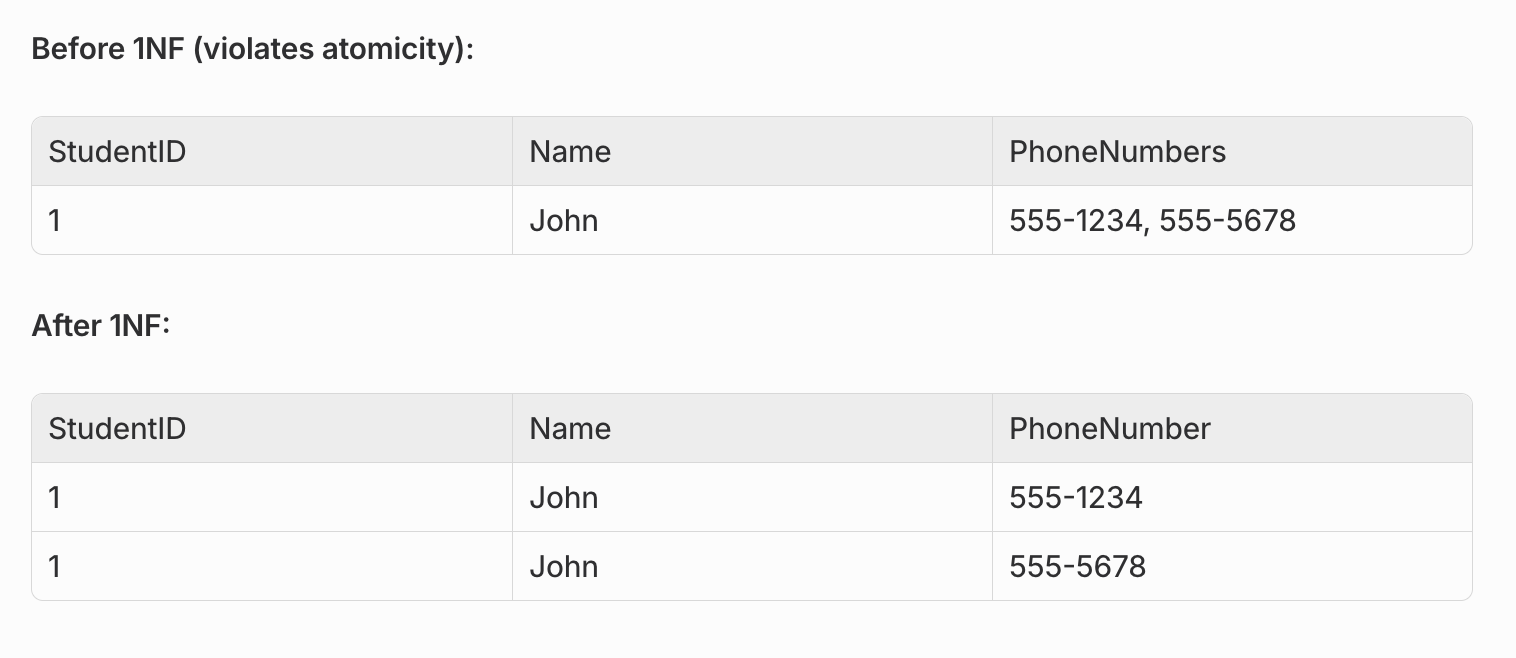
1. First Normal Form (1NF)
Rule: Each column must contain atomic (indivisible) values. No repeating groups or arrays.
2. Second Normal Form (2NF)
Rule: Must be in 1NF, and all non-key attributes must depend on the entire primary key (no partial dependencies).
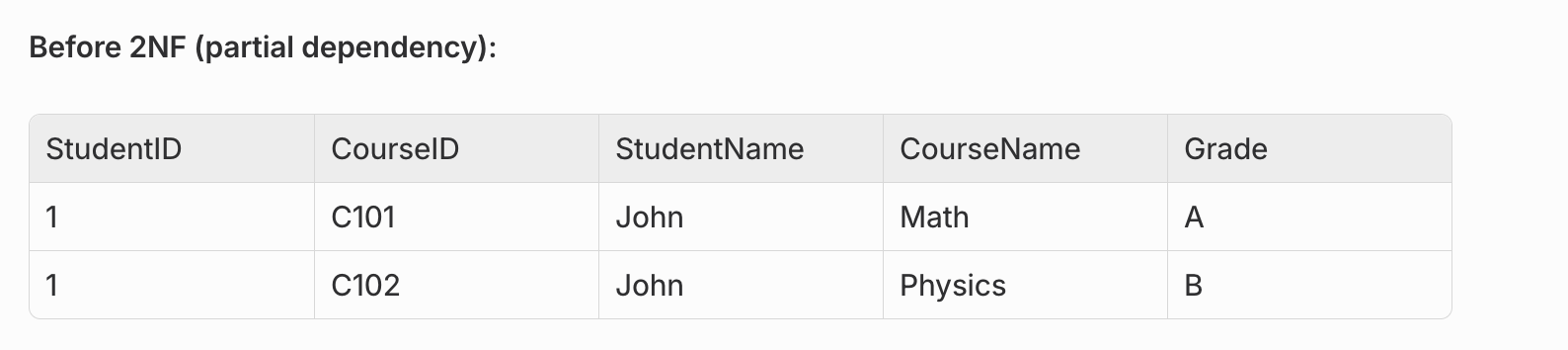
Problem: StudentName depends only on StudentID (part of the composite key), not on the full key (StudentID, CourseID).

3. Third Normal Form (3NF)
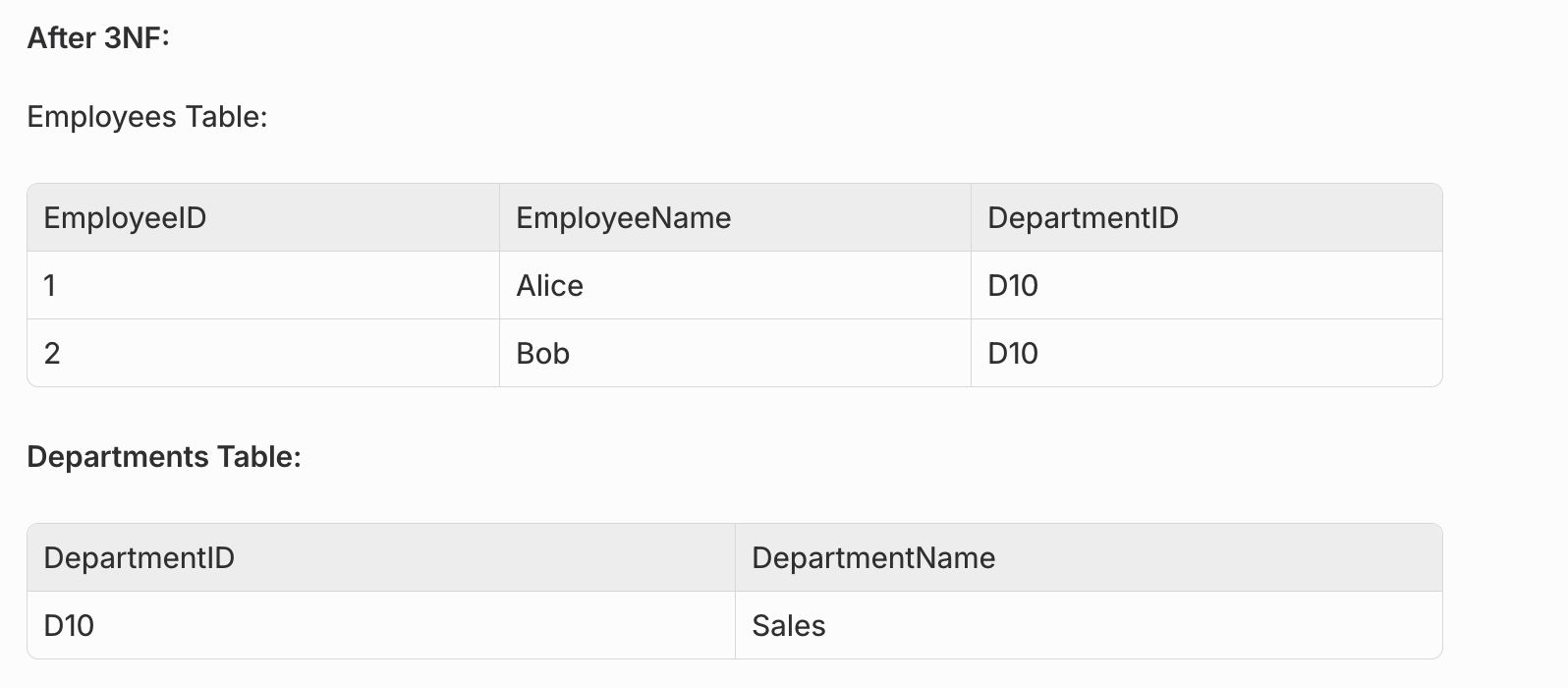
Rule: Must be in 2NF, and no non-key attribute should depend on another non-key attribute (no transitive dependencies).
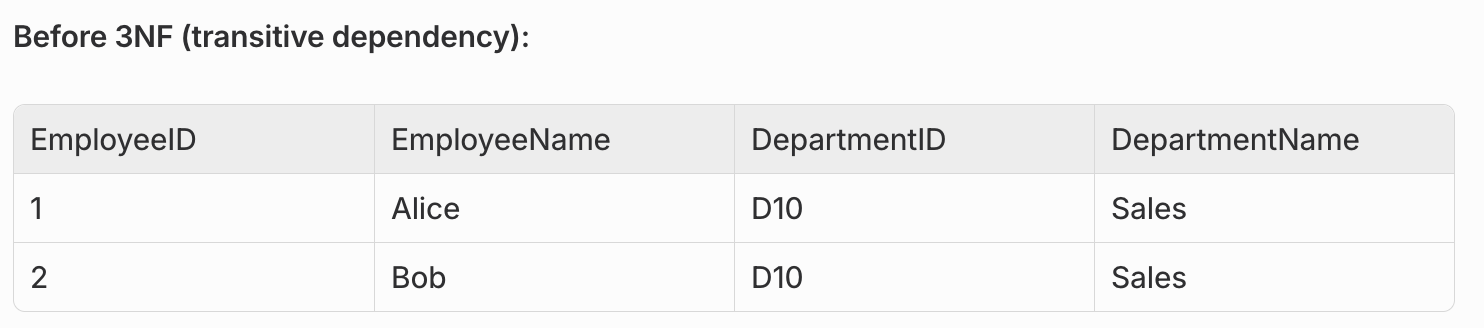
Problem: DepartmentName depends on DepartmentID, which depends on EmployeeID (transitive dependency).
4. Boyce-Codd Normal Form (BCNF)
Rule: Must be in 3NF, and every determinant must be a candidate key.

Problem: Professor determines Subject (each professor teaches only one subject), but Professor is not a candidate key.

5. Fourth Normal Form (4NF)
Rule: Must be in BCNF, and no multi-valued dependencies (independent attributes should be in separate tables).
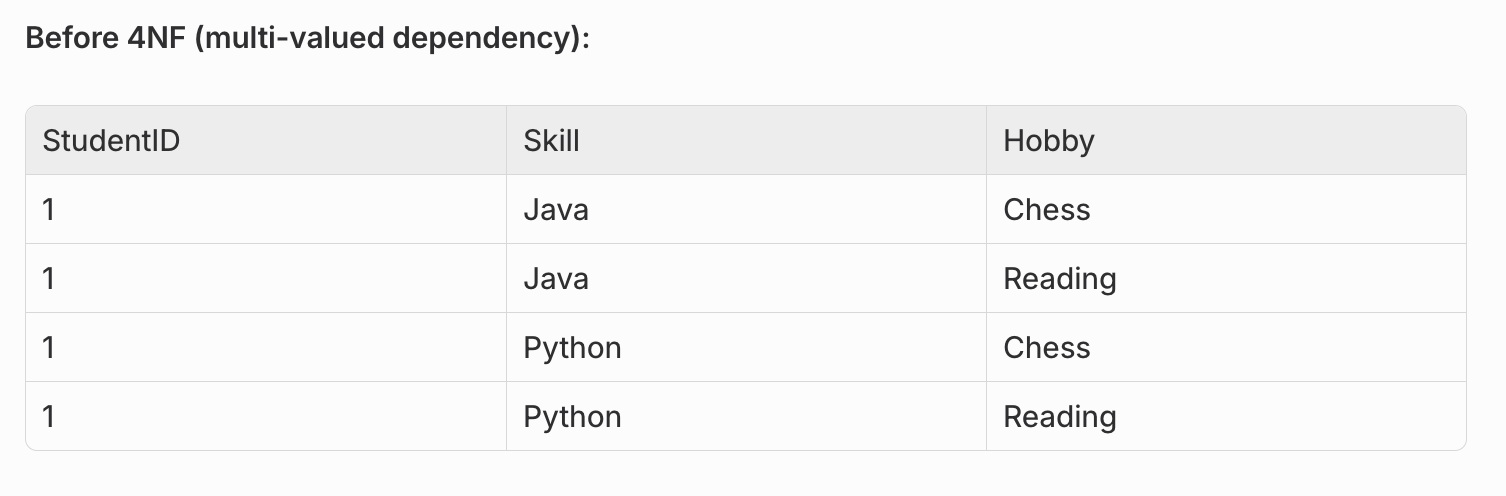
Problem: Skills and Hobbies are independent of each other, creating redundancy.

6. Fifth Normal Form (5NF)
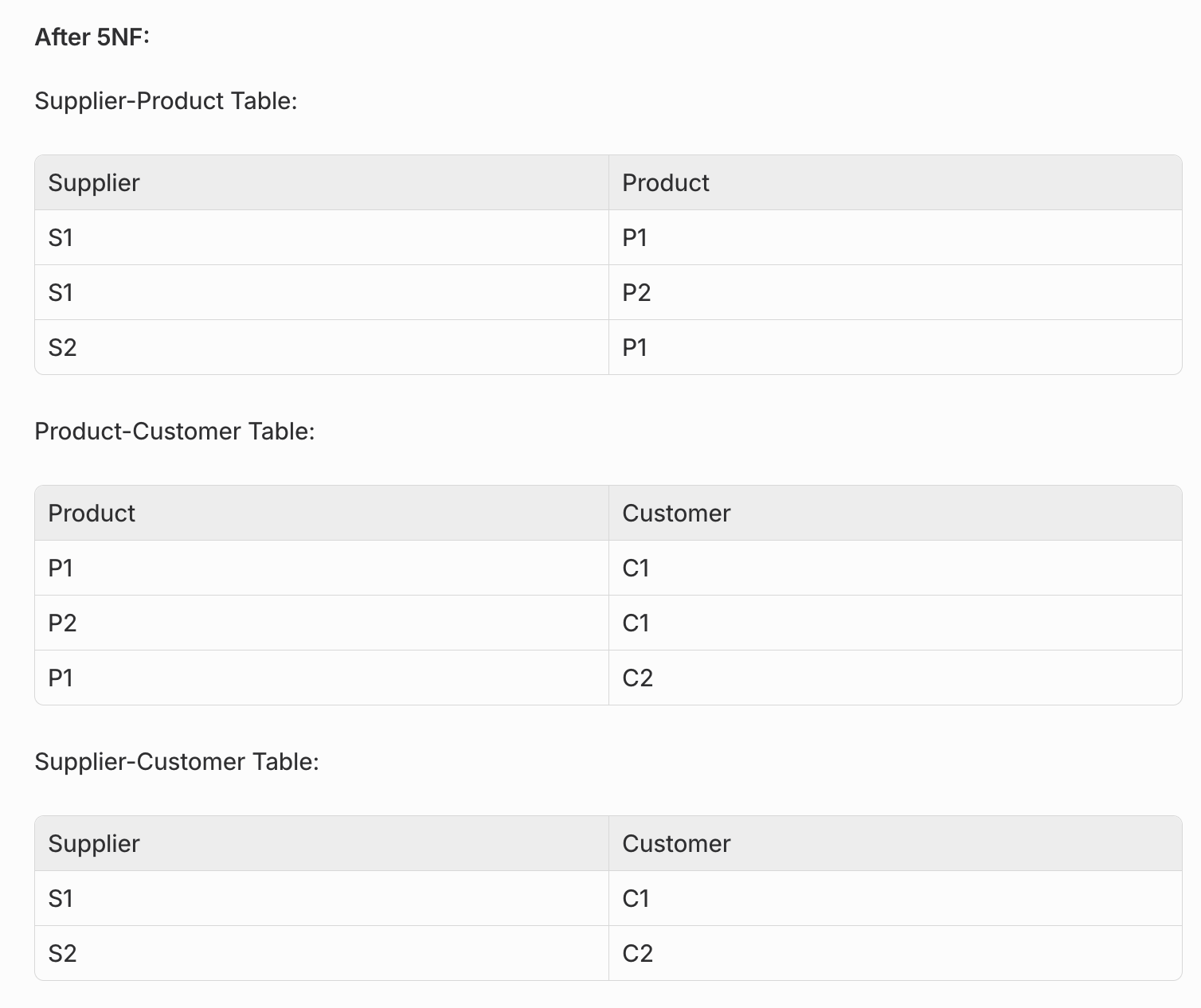
Rule: Must be in 4NF, and the table cannot be decomposed into smaller tables without losing information (no join dependencies).
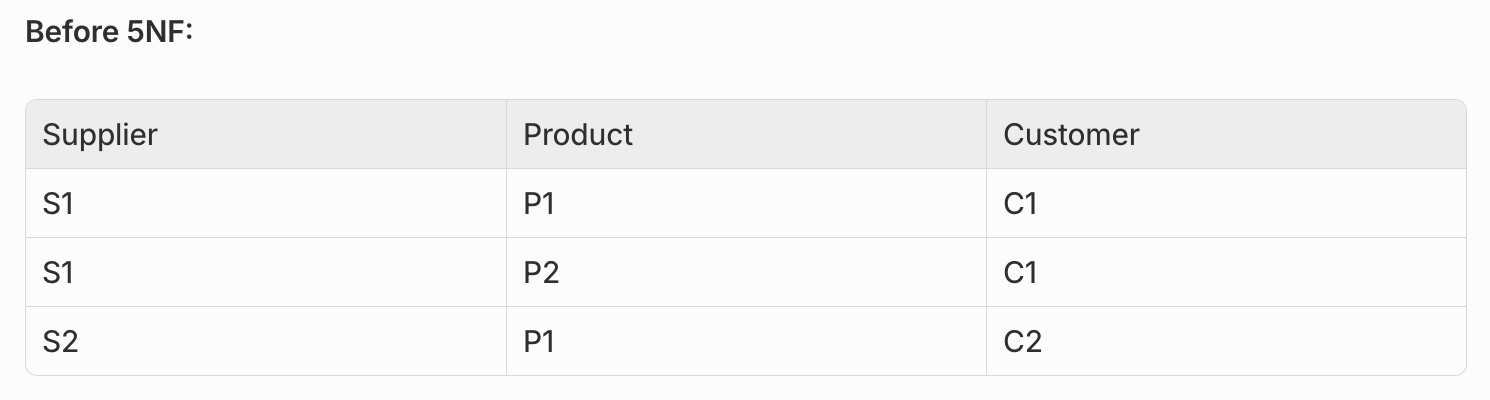
Problem: If we know S1 supplies P1, and C1 orders P1, we can infer S1 can supply P1 to C1.
7. Domain-Key Normal Form (DKNF)
Rule: All constraints are enforced through domain constraints (data type restrictions) and key constraints (primary/foreign keys) alone.

Where:
OrderID is primary key (key constraint)
CustomerID is foreign key to Customers table (key constraint)
OrderDate must be a valid date (domain constraint)
TotalAmount must be a positive decimal (domain constraint)
What Are Data Normal Forms in Frontend?
While frontend development doesn’t follow the strict normal form hierarchy of databases, we can identify analogous principles that guide state normalization in applications using Redux, Zustand, or similar state management solutions.
Frontend First Normal Form: Flat Entities
Principle: Store each entity type in a flat lookup table keyed by ID.
// Instead of nested arrays...
const users = [{ id: 1, name: ‘Alice’ }, { id: 2, name: ‘Bob’ }];

// Use flat lookup tables
const users = { 1: { id: 1, name: ‘Alice’ }, 2: { id: 2, name: ‘Bob’ } };
Frontend Second Normal Form: ID References
Principle: Replace nested objects with ID references.
// Instead of embedding the full author object...
const post = { id: 1, author: { id: 101, name: ‘Alice’ } };

// Store only the reference
const post = { id: 1, authorId: 101 };
Frontend Third Normal Form: Separate Entity Stores
Principle: Keep each entity type in its own dedicated slice of state.
const state = {
  entities: {
    users: { /* user entities */ },
    posts: { /* post entities */ },
    comments: { /* comment entities */ }
  },
  ui: { /* UI-specific state */ }
};
Frontend BCNF: Computed vs Stored Data
Principle: Don’t store data that can be computed from other state.
// Don’t store computed values
const cart = { items: [...], totalPrice: 99.99 }; // Bad

// Compute them with selectors
const cart = { items: [...] };
const selectTotalPrice = (state) =>
  state.cart.items.reduce((sum, item) => sum + item.price, 0);
Frontend Fourth Normal Form: Relationship Tables
Principle: For many-to-many relationships, create separate relationship mappings.
const state = {
  users: { /* user entities */ },
  groups: { /* group entities */ },
  userGroups: {
    byUser: { 1: [10, 20], 2: [10] },   // userId -> groupIds
    byGroup: { 10: [1, 2], 20: [1] }    // groupId -> userIds
  }
};
Higher Normal Forms in Frontend
Frontend applications rarely need to consider 5NF, 6NF, or DKNF equivalents. The four principles above cover the vast majority of state management scenarios. However, complex applications might benefit from temporal state tracking (similar to 6NF) for features like undo/redo history or audit logs.
When NOT to Normalize in Frontend
While normalization offers many benefits, there are scenarios where denormalized data makes sense:
Read-heavy UIs: If data is displayed frequently but rarely updated, denormalized snapshots can reduce selector complexity.
Static data: Configuration or reference data that never changes doesn’t benefit from normalization overhead.
Performance-critical renders: Sometimes duplicating data avoids expensive joins during render cycles.
The key is to normalize by default, then denormalize strategically where profiling shows a clear benefit.
How Normalization Helps Memory Management
Normalization directly impacts memory usage and application performance, both in databases and frontend applications.
Frontend Memory Benefits:
Single Source of Truth: Each entity exists once in memory, regardless of how many places reference it.
O(1) Lookups: Object key access is constant time versus O(n) array searching.
Efficient Updates: Changing an entity updates it everywhere automatically through references.
Optimized Re-renders: Shallow equality checks become reliable, enabling React.memo and useMemo optimizations.
Predictable State Changes: Immutable updates to normalized state are straightforward and debuggable.
Conclusion
While Database Normalization (1NF-6NF) focuses on storage efficiency and data integrity on the disk, Frontend Normalization focuses on update efficiency and UI consistency in memory.
By applying the principles of flattening data and managing relationships via IDs—much like a relational database—frontend engineers can build applications that are easier to debug, faster to render, and significantly lighter on memory resources.
References